What Brands Actually Look For in a Media Kit (And Why Yours Might Be Costing You Deals)

Every rejected pitch feels like it's about the brand not being interested. Sometimes that's true. But a surprising number of "no responses" never actually get read past the media kit — because the media kit itself quietly disqualified you before anyone judged your content.
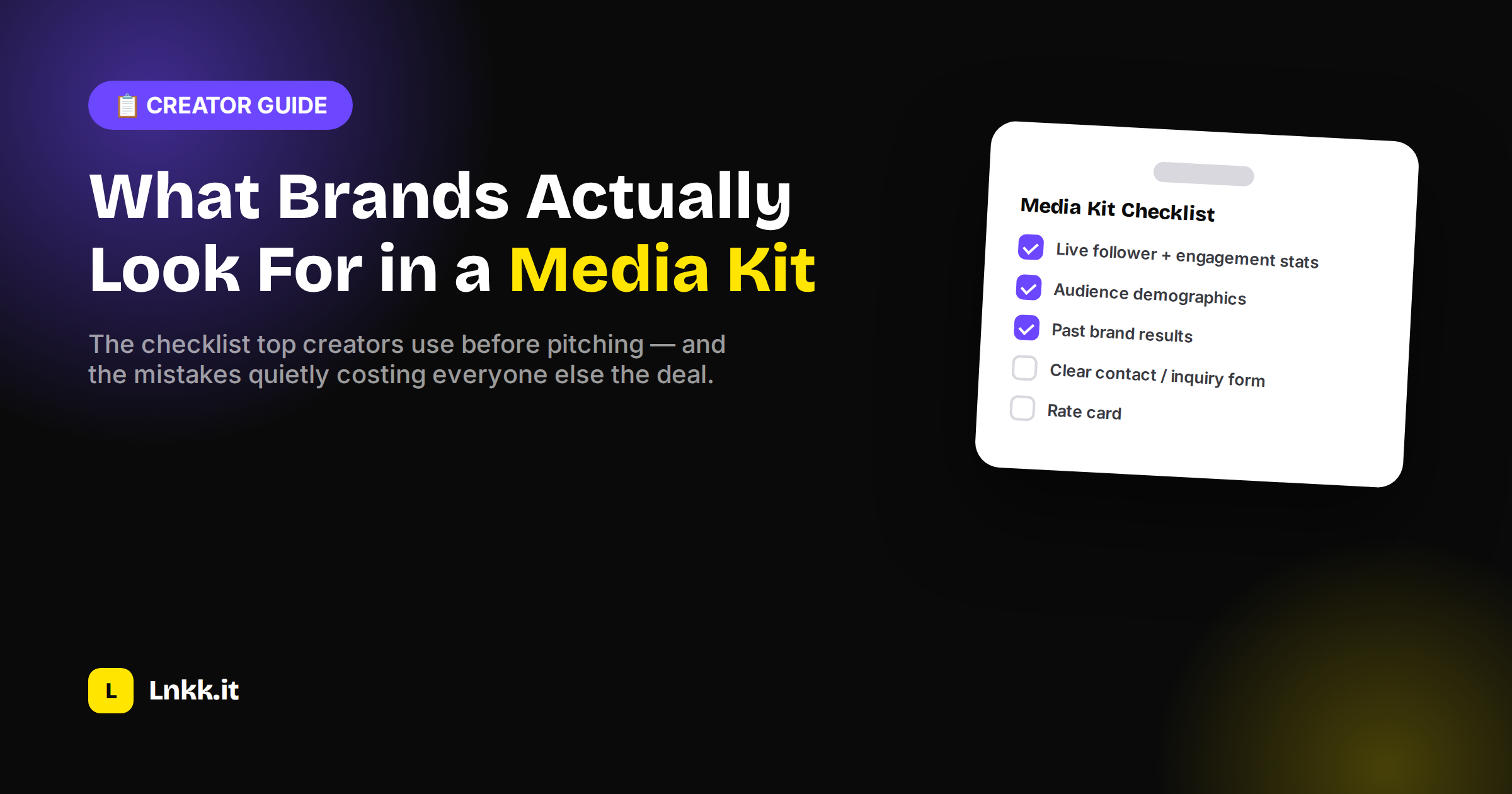
Here's exactly what brand managers are checking for in 2026, in roughly the order they check it, and how to make sure your media kit survives that first four-second scan.
Why This Matters More Than It Used To
Audience-fit verification has gone from a nice-to-have to standard due diligence: one 2026 industry report found 76% of brands now check a creator's audience demographics before committing to a partnership, up sharply from just 52% a few years ago. That shift alone explains why a media kit that only shows a follower count — with no breakdown of who's actually behind that number — gets far less traction than it used to.
Brands aren't being harder to please for no reason. They've been burned by creators whose "engaged audience" turned out to be mostly inactive follows or a demographic mismatch, and due diligence is the direct response.
What Brands Actually Check First
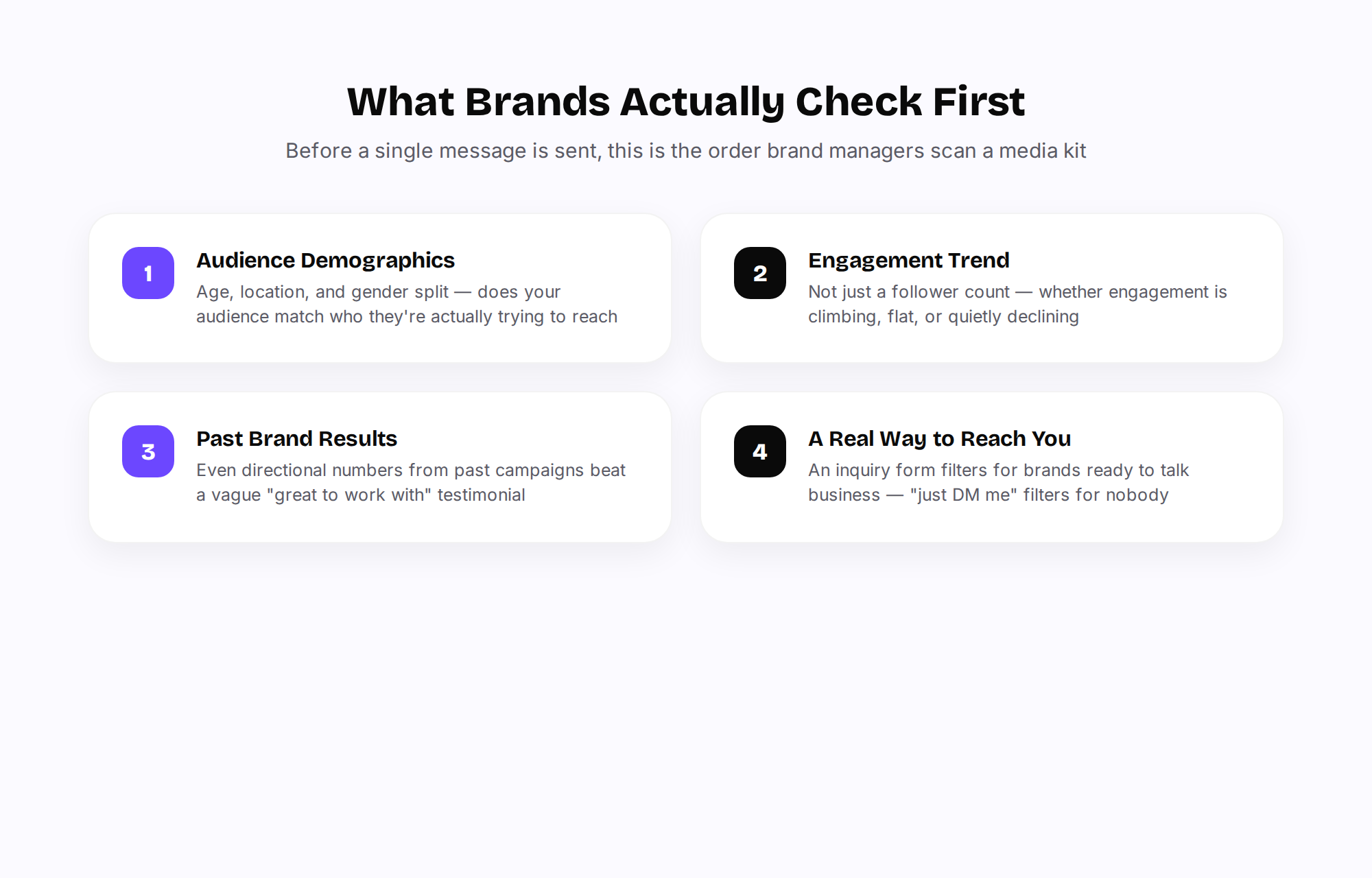
1. Audience demographics. Not your follower count — who those followers actually are. Age range, location, and gender split matter more to a brand than raw reach, because a creator with 20K perfectly-matched followers is a better bet than one with 200K followers who don't fit the target customer at all.
2. Engagement trend, not just engagement rate. A single engagement number tells a brand almost nothing on its own — it needs context. Worth knowing: reported average engagement rates vary enormously by creator size, with smaller creators often posting notably higher engagement than mega-influencers, according to 2026 industry benchmarking. A brand checking your number is usually asking "is this normal for someone your size," so showing a trend over time is more convincing than a single static figure.
3. Past brand results, with actual numbers. "Great to work with!" as a testimonial says nothing. Even directional data — reach, click-throughs, saves, a screenshot of a past brand's own feedback with real numbers attached — does more work than paragraphs of praise.
4. A real way to reach you. This sounds minor and isn't. "Just DM me" filters out exactly nobody, including brands that aren't serious. A proper inquiry form or booking link filters for people who are actually ready to talk business, and it makes you look like you run this as an operation, not a hobby.
The Mistake That's Easiest to Fix (And Most Common)
Stale data. A media kit is, at its core, a digital resume for your creator business — and a resume with a job you left two years ago still listed as "current" doesn't inspire confidence. The same logic applies here: brands can often tell when a media kit hasn't been touched in months, because the numbers don't line up with what a quick profile check shows them.
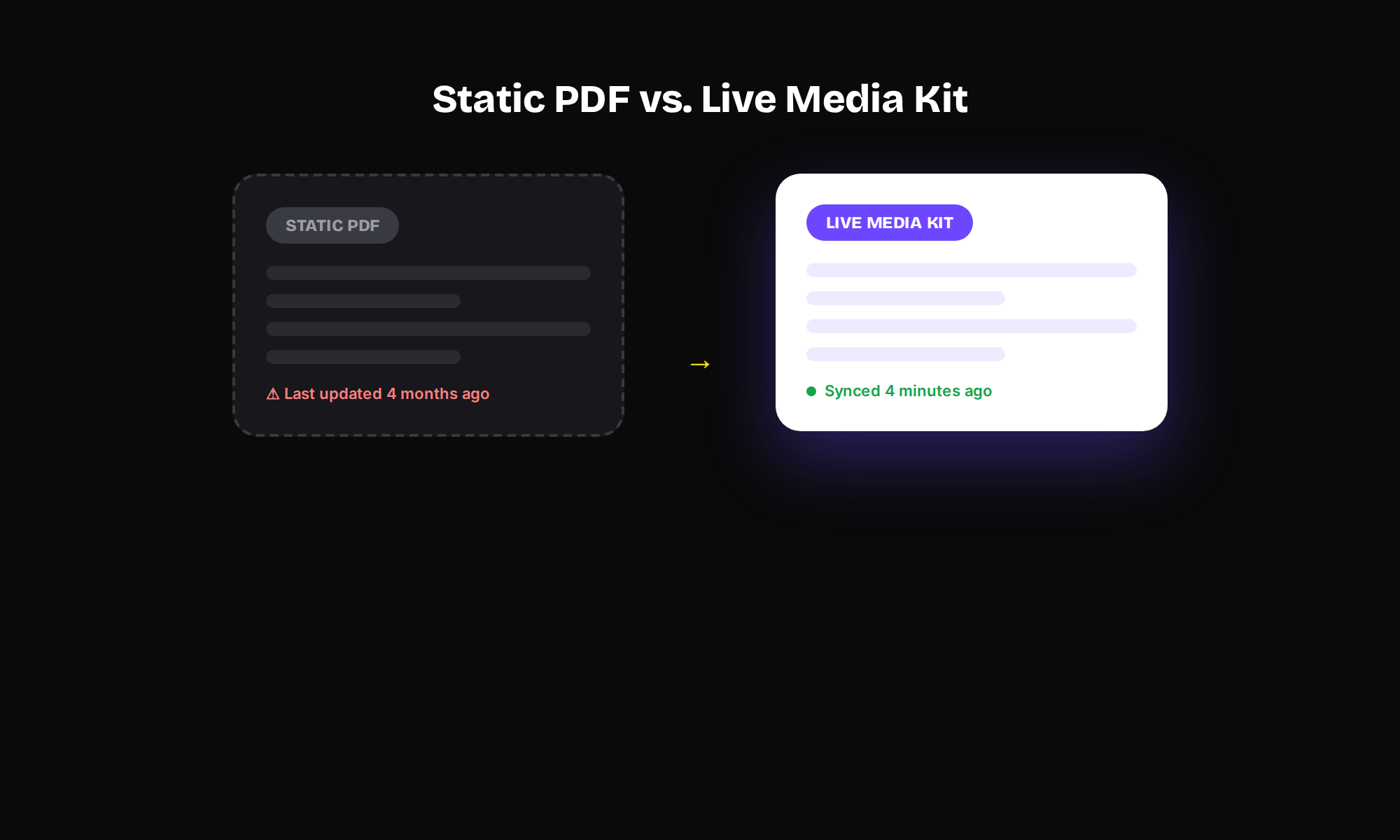
This is the single highest-leverage fix available, because it's not a content problem — it's a maintenance problem. The fix isn't writing better copy. It's removing the need to remember to update anything at all.
The Anatomy of a Media Kit That Actually Converts
Putting the checklist together, a strong media kit in 2026 includes:
Live follower count and engagement rate — current, not from memory
Audience demographics — age, location, gender split
A specific bio — what you make content about and for whom, not a generic "content creator" line
Past brand work with results, even directional numbers
A rate card — gated if you'd rather qualify inquiries first
A clear inquiry path — form or booking link, not just a DM prompt
How to Build One That Updates Itself
Rather than rebuilding a PDF every time your stats move, Lnkk.it's Media Kit tool connects directly to your Instagram and YouTube accounts and keeps your follower count, engagement rate, and audience breakdown current automatically. You can gate your full rate card behind a simple unlock, and route inbound brand interest straight to an inquiry form instead of a DM you'll lose track of by next week. It's free to set up — connecting your accounts takes about five minutes.
Pair It With the Rest of Your Setup
A strong media kit works best when it's not the only professional-looking part of your presence:
Send brand traffic to a link-in-bio page that looks intentional, not a flat list of links
If a brand wants to buy something directly rather than sponsor a post, have a Creator Store ready to point them to
If your growth story leans on Instagram engagement, our comment-to-DM automation guide covers the mechanic that's likely driving a chunk of the numbers your media kit is showing off
If you're comparing media kit tools across platforms, our Lnkk.it vs. Beacons breakdown covers how the two stack up on this specific feature, among others.
FAQ
How often should I update my media kit? If it's not auto-syncing, monthly at minimum — and always right before sending it to a specific brand.
Do I need a media kit if I only have a few thousand followers? Yes, arguably more than a larger creator does. Brands increasingly favor smaller, more engaged audiences for fit and cost reasons, and a clear, current media kit is how you prove that fit before they ask.
Should I include pricing in my media kit? Optional — some creators prefer a gated rate card that qualifies serious inquiries, others prefer transparency upfront. Either works; inconsistency (no pricing anywhere, and no way to ask) is what causes drop-off.
What's the single biggest mistake creators make? Sending a media kit that's months out of date. It's rarely a content problem — it's almost always a maintenance problem, which is exactly what an auto-syncing media kit removes.
Ready to stop rebuilding your media kit by hand? Set yours up free — connect your accounts once, and let the numbers keep themselves current.
YOU MAY ALSO LIKE
Why Smart Creators Are Ditching Linktree in 2026 (And What They're Using Instead)
Stop Repeating Yourself: The Ultimate Guide to the Lnkk.it FAQs App
Imagine reclaiming 5 hours of your week by automating answers to your most common DMs. The Lnkk.it FAQs App builds trust, saves time, and organizes your info beautifully.
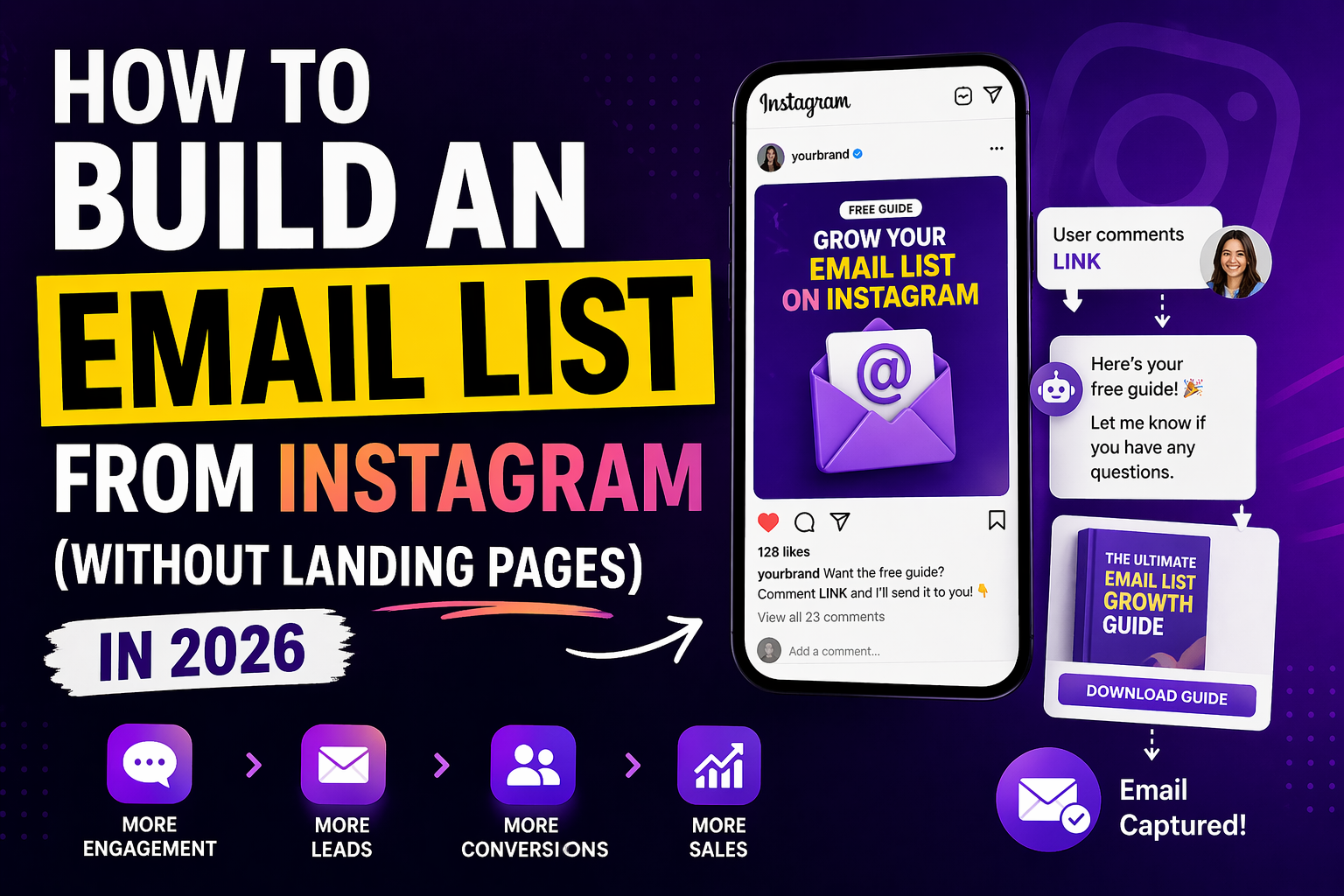
How to Build an Email List From Instagram (Without Landing Pages) in 2026
Stop losing followers to algorithm changes. Learn 3 proven methods to capture emails directly from Instagram DMs — no landing pages, no paid ads, no complicated funnels. Real numbers from real creators.